Cat vs Human Senses
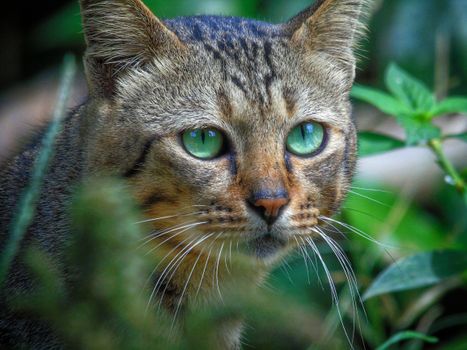
Visual Acuity Comparison
Cats and humans perceive the world differently due to distinct visual capabilities. Cats have a visual acuity of 20/100 to 20/200, meaning they must be 20 feet away to see what humans can at 100-200 feet (American Academy of Ophthalmology, 2020). However, their tapetum lucidum—a reflective eye layer—boosts low-light vision, making them 6 times more light-sensitive than humans. While humans see a full color spectrum, cats primarily detect blues and violets, with limited red perception.
| Feature | Cats | Humans |
|---|---|---|
| Visual Acuity | 20/100 to 20/200 | 20/20 |
| Color Vision | Blues/violets | Full spectrum |
| Low-Light Vision | Excellent (tapetum lucidum) | Poor |
Hearing Range Comparison
Cats outperform humans in detecting high-frequency sounds. Their hearing range extends to 79 kHz, compared to humans’ 20 kHz (Journal of the Acoustical Society of America, 2019). This allows cats to hear ultrasonic rodent communications (40-60 kHz). Their mobile ears can rotate 180 degrees to pinpoint sounds within 3 inches accuracy at 1 meter.
Smell Sensitivity Comparison
With 200 million olfactory receptors (vs. humans’ 6 million), cats smell 14 times better (Scientific American, 2018). They use the vomeronasal organ to detect pheromones, crucial for social bonding. Products like the Feliway Multicat Diffuser en Amazon mimic these pheromones to reduce stress.
Practical Implications for Cat Owners
- Hearing: Use high-pitched toys (e.g., Cat Dancer 241 en Amazon (16-22 kHz)) to engage their superior hearing.
- Smell: Introduce pheromone sprays or catnip (nepetalactone) weekly for enrichment.
- Vision: Place perches near windows for vertical sightlines and use blue/violet toys.
Age-Related Changes in Cat Senses
Senior cats (11+ years) often develop hearing loss (32% prevalence) and cataracts (15% prevalence) (Journal of Feline Medicine and Surgery, 2020). Mitigate this by:
- Keeping furniture arrangements consistent.
- Using vibrating collars for deaf cats.
- Scheduling bi-annual vet checkups.
Tips for Stimulating Your Cat’s Senses
- Olfactory: Grow cat-safe plants (valerian, silver vine) indoors.
- Auditory: Play bird chirping sounds at 50 dB for 10-minute sessions.
- Visual: Rotate interactive laser toys (avoid direct eye exposure).
Frequently Asked Questions
How far can cats see clearly?
Cats see clearly up to 20 feet, compared to humans’ 100-200 feet. Their blurry long-distance vision is offset by motion detection at 1/100th the light humans need.
Why do cats react to ultrasonic sounds?
Cats hear up to 79 kHz, allowing them to detect prey like mice (40-60 kHz). This evolutionary trait makes ultrasonic pest repellents stressful for cats.
How strong is a cat’s smell compared to dogs?
Dogs have 300 million receptors, but cats’ 200 million still surpass humans’ 6 million. Cats specialize in pheromone detection for social cues.
Do cats see in complete darkness?
No. Cats need 1/6th the light humans do but rely on starlight or moonlight. Total darkness renders them as blind as humans.
Can cats see TV screens?
Yes, but modern 120Hz+ screens appear smoother to cats. They prefer high-contrast, moving objects (e.g., bird documentaries).
My Take
As a developer who works from home with two cats, I’ve noticed how Miso (my tabby) reacts to ultrasonic phone notifications—she’ll wake from a dead sleep at frequencies I can’t hear. I’ve switched to vibrate mode after learning about their hearing range. For sensory enrichment, I freeze chicken broth in ice cube trays—the slow melt releases odors that keep them engaged for hours. It’s a chef’s trick repurposed for feline fun!
You might also like
- Socializing Cats That Don’t Get Along
- Factors Affecting Indoor Cat Lifespan
- Longest Cat Climb Guinness Record
- how to introduce two aggressive cats safely
Practical Summary
- Hearing: Avoid ultrasonic devices; opt for 50 dB chirping toys.
- Vision: Use blue/violet toys and vertical climbing spaces.
- Smell: Introduce pheromone diffusers or catnip 2-3 times weekly.
- Aging Cats: Non-slip rugs and consistent feeding spots reduce disorientation.
- Enrichment: Puzzle feeders with 1/4 tsp treats stimulate multiple senses.
- Vet Care: Annual smell/vision tests for cats over 7 years.
Written by Vladys Z. — App developer and professional chef. Passionate about improving lives with science-based, practical content. Follow me on YouTube.
📚 Continue reading
Sources
- American Academy of Ophthalmology (2020). Comparative Vision in Mammals.
- Journal of the Acoustical Society of America (2019). Feline Auditory Thresholds.
- Scientific American (2018). The Secret Life of Cat Senses.
- Journal of Feline Medicine and Surgery (2020). Geriatric Sensory Decline in Cats.
- International Cat Care (2022). Environmental Enrichment Guidelines.
Related articles
Félicette Space Cat
Discover the amazing true story of Félicette, the first cat in space

Félicette the Cat in Space
Meet Félicette, the first cat in space, and learn about her incredible story.
Félicette First Cat in Space
Discover the incredible story of Félicette, the first cat in space and what made her mission a success.